If you’ve ever tried to install an IP camera or a wireless access point without an outlet nearby, you’ve already run into the Power over Ethernet problem. The question is never really whether you need PoE – it’s which solution fits your setup without creating more headaches down the road.
Let’s break this down in plain terms so you can make a confident decision.
What Is Power over Ethernet, and Why Does It Matter?
Power over Ethernet (PoE) is a technology that lets a single Ethernet cable carry both data and electric power to a connected device. Instead of running a separate power cable to every IP camera, VoIP phone, or wireless access point, you use the existing network infrastructure to do both jobs at once.
This simplifies electrical wiring, reduces clutter, and makes installations faster – especially when you’re working in areas where AC power plugs and sockets aren’t easy to reach.
The PoE Injector: Simple, Targeted, Affordable
A PoE injector is a small device that sits between your router or standard network switch and a single PoE-powered device. It “injects” electric power into the Ethernet signal without requiring a full switch upgrade.
When a PoE Injector Makes Sense
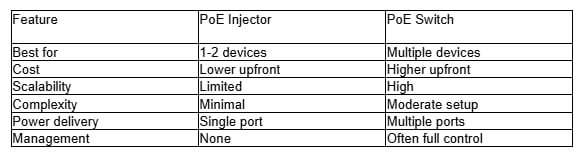
An injector is the right call when you only need to power one or two devices – think a single IP camera at a gate, or a Wi-Fi access point in a hard-to-wire corner of a building. The cost is low, the complexity is minimal, and you don’t have to replace any existing equipment.
If your current computer network is already set up the way you want it, and you just need to add power to one device, an injector keeps things simple. It’s also a solid choice for temporary installations or testing.
The downside? Injectors don’t scale. Each one powers a single device, so if your system grows, you’ll end up with a pile of injectors, tangled power cables, and a management nightmare.
The PoE Switch: Built for Bigger Systems
A PoE switch is a full network switch with Power over Ethernet built in. It follows the IEEE 802.3 standard and delivers power and data to multiple devices through a single piece of infrastructure.
When a PoE Switch Is the Smarter Investment
If you’re running a multi-camera surveillance system, several VoIP phones, or a wireless network with multiple access points, a PoE switch is the cleaner, more scalable solution. Managed PoE switches give you control over voltage output, energy usage, and individual port settings – all from one dashboard.
A switch also handles data communication more efficiently across a network. You’re not daisy-chaining power adapters; you’re running a clean, professional setup where every device pulls power and signal through Category 5 cable or better.
The tradeoff is the upfront cost. A quality PoE switch costs more than a single injector. But when you factor in long-term complexity, cable management, and the cost of scaling an injector-based setup, the switch usually wins.
PoE Injector vs PoE Switch: A Quick Comparison
 What About Ethernet Extenders and Other Add-Ons?
Some setups use an Ethernet extender to push a signal further than standard cable lengths allow. In these cases, knowing whether your switch or injector supports the required voltage and data throughput matters. Not all PoE equipment handles extended distances or audio networking well, so check the specs before buying.
Voice over IP systems, in particular, are sensitive to signal degradation. If you’re mixing VoIP phone systems with video surveillance on the same network, a managed PoE switch gives you the control to prioritize electric power transmission where it’s needed most.
Which One Should You Choose?
If you’re adding one device, go with the injector. If you’re building or expanding a real system – whether that’s for a home, a business, or a commercial property – invest in a PoE switch from the start. It saves time, reduces clutter, and grows with your needs.
Conclusion
Choosing between a PoE injector and a PoE switch comes down to how many devices you need to power and where your system is headed. One device? An injector works. A full security or network setup? A switch is the smarter long-term call. True Home Protection’s team helps homes and businesses across Texas design and install structured cabling and surveillance systems that are built to scale. If you’re planning a new install or upgrading an existing one, explore our Structured Cabling and Network Installations service to get started the right way.