You’ve decided to add cameras to your property. Smart move. But now you’re staring at two very different options: the bullet camera and the dome camera. One looks like a small telescope mounted to your wall. The other sits flush against the ceiling like a dark, watchful eye.
Both are legitimate closed-circuit television system options. Both do the job. But which one is right for your roof line, your mounting surface, and your specific surveillance needs? That depends on more than personal preference.
What Actually Separates a Bullet Camera from a Dome Camera
At the most basic level, these two camera types differ in physical design and how they handle light, angle, and installation. The bullet camera is a long, cylindrical housing that mounts to a wall or soffit using a bracket. The dome camera, true to its name, sits inside a rounded dome housing and typically mounts flush to a ceiling.
That design difference isn’t cosmetic. It directly affects your field of view, your angle of view, and how well each camera handles real-world conditions like fog, spiders, and Texas heat.
The Bullet Camera: Built for Distance and Deterrence
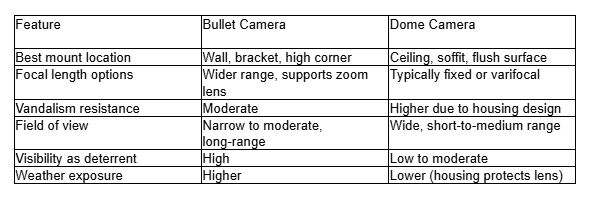
A bullet camera’s shape allows it to house a longer focal length lens, sometimes including a zoom lens with serious reach. If you need to monitor a long driveway, a parking lot, or the street in front of your property, a bullet camera gives you the image detail to actually identify a vehicle or face at a distance.
The exposed design also acts as a visual deterrent. Vandals are less likely to approach a property when they can clearly see a camera pointing at them. That visibility is a genuine advantage.
However, the bullet’s external lens is more exposed to the elements. In areas with heavy fog, insects, or direct sunlight, you may notice glare or reduced image quality. A spider spinning a web over your camera lens at 2 a.m. is not as funny as it sounds when you’re reviewing footage the next morning.
The Dome Camera: Discreet, Flexible, and Harder to Redirect
The dome camera hides its lens behind a tinted or clear dome housing. This makes the angle of the camera lens difficult to determine from the outside, which is a useful security feature in itself. Potential intruders cannot easily tell where the camera is pointed.
Dome cameras are also harder to vandalize or physically redirect. The housing protects the lens, and because they typically mount to the ceiling rather than a wall, they’re less accessible. The IP code rating on most commercial-grade dome cameras is designed to handle dust, moisture, and even direct tampering attempts.
The tradeoff is that dome cameras typically have a wider, shorter-range field of view. They’re better suited for monitoring large interior spaces, entryways, covered patios, and areas under a soffit or eave. A fisheye lens variant can cover nearly an entire room, but at the cost of image distortion at the edges.
How Your Roof Line and Mounting Surface Change Everything
This is the part most people overlook. The question is not just “which camera is better” – it’s “which camera works with my specific mounting location.”
Consider the mounting styles:
- The soffit first. A soffit mount – that horizontal surface under your roof overhang – is ideal for dome cameras. The camera faces downward at a natural angle, the housing is protected from direct rain, and the wide-angle lens covers the area directly beneath it effectively.
- The wall or bracket mount next. A bullet camera on a bracket, mounted high on a wall or at the corner of a structure, can cover a much longer line of sight. It points outward rather than downward, making it the better choice for monitoring approach paths, gates, or perimeter lines.
If you have both covered soffits and long open sightlines on your property – which is common in Texas homes with wide lots – you may actually need both camera types working together as part of a larger closed-circuit television system.
Comparing Key Specs Side by Side
Does Camera Software Matter More Than Hardware?
Increasingly, yes. Modern surveillance systems rely heavily on software to process the image, detect motion, send alerts, and store footage. Whether you choose a bullet or dome camera, the intelligence behind the camera often determines how useful your footage actually is.
Features like license plate recognition, person detection, and remote access through a security app are driven by software, not just the camera lens itself. This is worth keeping in mind when comparing systems.
Frequently Asked Questions
Can I mix bullet and dome cameras on the same system?
Yes. Most modern IP-based surveillance systems support both types. Many well-designed systems use dome cameras for entryways and interior coverage while using bullet cameras for long-range perimeter monitoring.
Which camera type holds up better against vandalism?
Dome cameras generally resist vandalism better due to their enclosed housing and ceiling placement. Vandals have a harder time reaching or redirecting them. That said, any camera mounted out of reach is difficult to tamper with.
Are bullet cameras better for outdoor use?
It depends on exposure. A bullet camera mounted under a soffit or roof overhang performs well outdoors. One mounted directly in the sun or in an area prone to fog and condensation may need a higher IP code rating to stay reliable.
What focal length should I choose?
For short-range, wide coverage, a shorter focal length works. For identifying vehicles or faces at a distance, a longer focal length or zoom lens is the better choice. A security professional can help you map out the right lens for each camera position on your property.
Which Camera Fits Your Roof Line Best?
Choosing between a bullet camera and a dome camera is not about which one is superior – it is about which one fits your roof line, mounting surface, and surveillance goals. Bullet cameras win on range and deterrence. Dome cameras win on flexibility, vandal resistance, and discreet coverage. Most properties benefit from a combination of both.
If you are ready to design a system that matches your specific layout, explore True Home Protection’s residential camera and video monitoring services or call +1-800-393-6461 to get started.