Let’s start with a question most business owners don’t think hard enough about: when something happens at your business at 2:47 a.m. on a Tuesday, who’s watching?
If the answer is “nobody, but I’ll see it on the app in the morning”, we need to talk.
There’s a massive difference between recording security cameras and monitored security cameras. Recording cameras are a forensics tool. They tell you what happened after the fact. Monitored cameras are a prevention tool. They stop bad things from getting worse, in real time, while they’re happening.
For Austin business owners, the gap between those two is the difference between filing an insurance claim and avoiding one entirely. This guide is going to break down exactly how 24/7 monitored camera systems work, why they’re worth the investment, and what we recommend for businesses across Central Texas.
What “24/7 Monitored” Actually Means
This is where a lot of business owners get sold a bill of goods, so let’s be precise.
A recorded camera system captures video to a local DVR or cloud server. You can pull it up later. That’s it.
A self-monitored system sends alerts to your phone when motion is detected. You, the busy business owner, are now the security guard. Hope you sleep light.
A professionally monitored system routes alarm and camera events to a UL-certified monitoring center, where trained operators are watching, verifying, and dispatching emergency services around the clock. They don’t sleep. They don’t take vacation. They don’t miss the alert because they were in a meeting.
When we say 24/7 monitored, we mean the third one. There are no off-hours. There’s no “I’ll check it later.” There’s a real human responding to your business’s alerts every minute of every day, including Christmas and during the next ice storm that takes down half the city.
That’s the standard. Anything less is just expensive recording.
Why Austin Businesses Specifically Need Monitored Camera Systems
Austin is booming. That’s mostly great news for business owners, but it comes with some realities that have shifted the security landscape over the past few years.
Police response times are stretched. APD and surrounding department response times for unverified alarms have grown across the metro, and some jurisdictions have moved toward verified-response policies, meaning if no human can confirm a real threat, your alarm gets deprioritized. Monitored cameras with visual verification flip that script. When the monitoring center can see the intruder, your call jumps the queue.
Property crime patterns shift fast. Commercial burglary trends in Austin don’t sit still. A corridor that was quiet last year might be hit three times this quarter. A monitored system gives you protection that adapts to current conditions, not last year’s conditions.
False alarm fines stack up. The City of Austin and surrounding municipalities charge real money for false alarms. A properly monitored system with visual verification dramatically cuts down on false dispatches, saving you both fines and your standing with local police.
Insurance discounts are tied to monitoring. Most commercial insurance carriers offer meaningful premium reductions for UL-certified, professionally monitored alarm and camera systems. Self-monitoring usually doesn’t qualify. That discount alone can offset the monthly monitoring cost.
The Texas heat is hard on equipment. Cheap consumer cameras die in Austin summers. A professionally installed and monitored system uses commercial-grade hardware that’s built for the climate, and gets actively watched, so when something fails, somebody knows about it before you do.
The Real Benefits of 24/7 Monitoring (Beyond “Somebody’s Watching”)
The headline benefit is obvious: somebody’s always watching. But here’s what business owners actually get out of monitored camera systems once they have one:
Sleep. This sounds like a soft benefit until you’ve been jolted awake at 3 a.m. by a glass-break alert and had to drive across town in your pajamas. Monitored systems let you turn that off. The pros handle it. You get your nights back.
Faster, smarter response. When monitoring center operators can see what’s happening, they can give dispatchers specifics: “Two males, dark clothing, exiting the rear loading dock now, headed east on foot.” That kind of detail changes outcomes.
Documented chain of evidence. If something does happen, monitored events come with logged timestamps, operator notes, and verified footage. That’s an evidentiary package that holds up far better than a screenshot from your phone.
Deterrence that actually works. Most criminals scope a target before hitting it. Visible commercial-grade cameras combined with active monitoring make your business a much less attractive target than the one down the street with the consumer kit from a big-box store.
Operational visibility. Monitored systems aren’t just for emergencies. The same infrastructure gives you tools for loss prevention, employee management, slip-and-fall defense, and operational analytics. The monitoring is the safety net; the system itself earns its keep every day.
Lower overall cost of ownership. This is the one nobody tells you about. Insurance discounts, reduced false alarm fines, lower theft and shrinkage, faster police response, fewer broken windows that don’t have to be replaced, monitored systems frequently pay for themselves and then some.
What Makes a Monitored System Actually Good
Not all monitoring is created equal. Before we get into specific products, here’s what separates a great monitored camera system from a mediocre one.
UL-Certified Monitoring Center
The monitoring center handling your alerts should be UL-certified, meaning it’s been independently audited for redundancy, staffing, response times, and procedures. If your provider can’t tell you which UL-certified center watches your account, that’s a red flag.
Visual Verification
This is the game-changer. Visual verification means when an alarm is triggered, the operator can immediately pull up the relevant camera and see whether it’s a real threat or a stray cat. It cuts false dispatches dramatically and gets law enforcement responding faster when it’s real.
Commercial-Grade Cameras
Resolution matters. Field of view matters. Low-light performance matters. Outdoor weather rating matters. The cameras are the eyes of the system, if they’re cheap, the whole system is cheap, no matter how good the monitoring is.
Encrypted, Reliable Alarm Panels
The panel is the brain. It needs to be encrypted (so nobody jams or spoofs it), reliable (so it doesn’t drop signals at the worst moment), and capable of integrating with cameras, access control, and smart sensors.
Local Backup and Cloud Redundancy
If your internet goes down, your system should keep recording locally and resume cloud sync when connectivity restores. If the cloud has a hiccup, you should still have your footage. Belt and suspenders.
A Local Service Partner
When something goes wrong with the install, a sensor stops reporting, a camera angle gets bumped, a panel needs a firmware push, you need a tech in a truck, not a phone tree in another country. This is where local matters most.
The Best Products We Install for Monitored Business Camera Systems
These are the systems we put into Austin businesses every week. Each plays a specific role, and we frequently mix them based on the building, the industry, and the threat profile.
UCC: One Platform for Everything
UCC is the unified command platform that ties together cameras, alarms, and access control under a single login. For a monitored business, UCC matters because it gives both you and the monitoring center one consolidated view of everything happening at your property.
When an alarm triggers, the operator pulls up the relevant cameras instantly through the same interface, no clicking between separate systems, no delay. For you as the business owner, it means you have the same situational awareness from your phone that the pros have at the monitoring center.
Best fit: any business serious about treating security as an integrated system rather than a stack of separate gadgets.
CHeKT: Visual Verification Done Right
If there’s one product that defines modern monitored camera systems, it’s CHeKT. CHeKT is what bridges your cameras with your UL-certified monitoring center, enabling actual visual verification of alarm events.
Here’s how it plays out in real life. An alarm trips at your business at 11:42 p.m. The monitoring center operator immediately pulls up the live camera feed tied to that zone. They see what’s there, a real intruder, an animal, an employee who forgot the code, a tree branch in the wind. Based on what they actually see, they either dispatch police with verified threat information or clear the alarm without burning a false dispatch.
The result: more real threats stopped, fewer false alarm fines, and a much higher priority response from law enforcement when it counts.
Best fit: every commercial monitored camera install we do. Honestly, this is the upgrade we recommend most often.
2GIG GoControl GC2e: Reliable, Encrypted Alarm Backbone
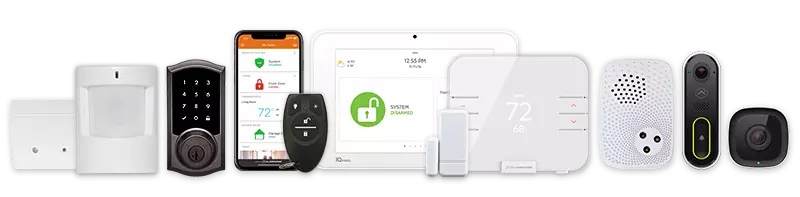
The 2GIG GC2e is one of our favorite alarm panels for small to mid-sized commercial spaces. It’s encrypted (resistant to signal jamming and spoofing), it’s well-supported, and it integrates cleanly with cameras and smart sensors.
For a monitored system, the panel is what actually communicates with the monitoring center. The GC2e does that job reliably, with cellular backup so a cut phone or internet line doesn’t take your security offline.
Best fit: small to mid-sized businesses, retail spaces, professional offices.
Brinks: Recognizable, Premium Equipment
Brinks brings name recognition that means something to customers, employees, and would-be intruders. The equipment is premium-tier with strong build quality and clean integration with the rest of the stack.
For monitored applications, Brinks gear gives you a polished, professional system that looks the part, a meaningful detail when the visible presence of security is part of your deterrence strategy.
Best fit: client-facing businesses where the security system is part of the brand experience.
DSC: The Workhorse for Larger Sites
DSC panels are the backbone of a huge percentage of serious commercial alarm installations. They’re expandable, they’re rock-solid, and they handle complex zone configurations without breaking a sweat.
For monitored larger commercial buildings, warehouses, big retail footprints, multi-area offices, DSC gives you the headroom to design the system right rather than retrofitting around the panel’s limitations.
Best fit: warehouses, larger commercial buildings, businesses with complex zone or partition needs.
How These Systems Apply to Your Industry
Monitoring is universal, but the system design varies by what you do.
Warehouses
Warehouse security systems live or die on overnight monitoring. Warehouses are mostly empty after hours, full of valuable inventory, and often situated in industrial corridors where help isn’t right around the corner. CHeKT visual verification combined with DSC panels and wide-coverage commercial cameras is the standard build for warehouse clients.
Schools
Schools have security needs that shift between school hours, after-school activities, weekends, and breaks. Monitored systems with visual verification are critical for after-hours protection, while UCC integration handles access control and visitor management during the day.
Offices
Office environments usually need monitoring focused on after-hours intrusion, plus daytime camera coverage for liability and incident review. The 2GIG GC2e or Brinks equipment paired with monitored cameras tends to be the right fit for most office footprints.
Restaurants and Food and Beverage
Food and beverage operations face a unique blend of risks, cash on hand, liquor inventory, slip-and-fall liability, late closing hours. Monitored systems with strong POS coverage and after-hours visual verification protect against both external threats and internal loss.
A Note for Austin-Area Business Owners Who Live Local
A lot of our commercial clients also live in the Austin metro and want their homes protected with the same level of professionalism as their businesses. If you’re in the Hill Country, our Lakeway home security services and broader Central Texas residential offerings work seamlessly alongside your business system, same monitoring center, same support team, same 24/7 standard. Your business and your home end up on the same page, with the same people watching out for both.
What Monitored Service Actually Costs
Monitoring is a monthly service, and pricing varies based on number of zones, cameras, level of integration, and whether you’re adding visual verification. But here’s our promise:
Transparent, itemized pricing. No hidden fees. No surprise rate hikes. You’ll see exactly what equipment costs, what installation costs, and what monthly monitoring will run, for the life of the contract.
We’re a Texas A+ BBB-rated local company, our monitoring is UL-certified, and we offer a Best Price Guarantee plus a Lifetime Limited Warranty on the equipment. That last one matters: if something we installed fails, we replace it. Not “we’ll see.” Not “let me check the warranty terms.” We replace it.
Ready to Stop Recording and Start Protecting?
If you’re running a business in Austin, Round Rock, Cedar Park, Lakeway, Buda, Pflugerville, or anywhere across Central Texas, and you’ve been getting by with a recording-only camera setup, we’d love to walk through what real 24/7 monitored protection could look like. No high-pressure pitch. No commission-driven up-sells. We’ll do a site walk, identify the real vulnerabilities, and put together a transparent proposal you can take your time with.
Call us at 1-800-393-6461 or request a free quote online. One of our local specialists will reach out, not a national call center, not an overseas line. Us. That’s integrity at its best. And when the alarm trips at 2:47 a.m., that’s exactly who you want on the other end of the line.