
If you’ve ever wondered how data smoothly moves between different parts of a building, or even between buildings, you’re likely dealing with a hidden hero: backbone cabling.
Whether you’re planning a small office, a large enterprise network, or upgrading your home or business tech infrastructure, understanding what backbone cabling is (and how it fits into your network) will help you make better, smarter decisions.
Let’s unpack backbone cabling in plain terms and explore why it’s essential to a robust, future-ready structured cabling system.
Understanding Backbone Cabling Explained
Backbone cabling forms the central nervous system of your entire network. It’s the high-capacity infrastructure that connects various parts of your building or campus together, like the equipment room, telecommunications rooms, and entrance facilities.
What Does Backbone Cabling Consist Of?
Backbone cabling consists of several key components:
- Backbone cable: This includes high-capacity cable types such as fiber optic cables, high-pair-count copper cables, or coaxial cables.
- Connecting hardware: Patch panels, connecting blocks, and other networking hardware facilitate interconnection points.
- Pathways and spaces: Conduit and cable trays route the cables through walls, floors, and ceilings efficiently.
- Main distribution frame (MDF) and intermediate distribution frames (IDFs): These are critical parts of the distribution system that manage routing between different network endpoints.
The backbone cable itself is typically designed for longer distances and higher bandwidth, making it the preferred choice for backbone infrastructure.
How Backbone Cabling Fits in Your Network Design
In a structured cabling system, cables are often organized in a star topology, connecting a central point like the main distribution frame to various intermediate distribution frames situated throughout the property. This setup improves network connectivity and scalability.
Backbone cabling must handle large amounts of data with minimal loss, making fiber optic or high-pair-count copper the go-to options for most installations.
Differences Between Backbone and Horizontal Cabling
Backbone and horizontal cabling serve different purposes but work together to complete the cabling infrastructure of any building or campus.
Backbone and Horizontal Cabling Differ in These Ways:
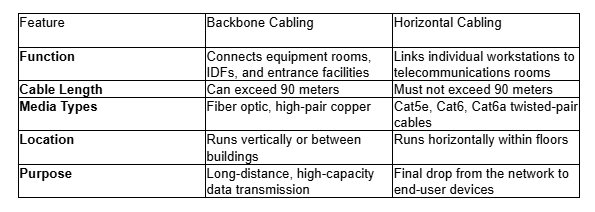
Understanding the differences between backbone cabling and horizontal cabling helps in choosing the right solutions for your network setup, especially for buildings with multiple floors or rooms within a large facility.
Cabling Structure: Backbone Versus Horizontal
In your cabling structure, the backbone cable is like a highway, allowing fast, uninterrupted data transfer between different areas, whether that’s the entrance facility and IDF or between multiple buildings.
Meanwhile, horizontal cable runs like local roads, reaching out from the telecom room to each workstation or work area outlet.
Both cabling forms are essential to ensure full network connectivity across all floors, departments, or workstations.
Key Cable Types for Backbone and Horizontal Cabling
Choosing the right cable ensures longer distances can be covered with minimal signal loss and strong bandwidth:
- Fiber optic cable: Best for high-bandwidth, long-distance runs and common in backbone cabling.
- Copper cables: Like twisted-pair Cat6 or Cat6a – ideal in short runs or when cost is a concern.
- Coaxial cables: Still used in some legacy or specific applications, such as cable television distribution.
Twisted-pair Ethernet options like Cat5e and Cat6 are popular in horizontal cabling within offices and commercial spaces.
Common Components Found in a Structured Cabling System
A structured cabling system provides a standardized architecture for your network. Here are the key parts:
- Entrance Facilities: Where your building connects to outside networks, like your ISP or telecom provider.
- Equipment Room: Hosts servers, routers, and the main patch panels.
- Telecommunications Room: Intermediate rooms housing network switches and patch panels for each floor or section.
- Horizontal Wiring: Cables from the telecom room to workstations.
- Work Area Outlet: The physical network jacks in walls or outlets where users connect end-user devices like computers or phones.
Why the Right Cable Management Matters
Efficient cable management systems are vital for keeping the network clean, serviceable, and safe. Whether routing through conduit, walls, ceilings, or racks, good management avoids tangled wires and makes future upgrades easier.
With devices like patch cords and patch panels, technicians can manage connections within telecommunications rooms, making maintenance more efficient and less error-prone.
Additionally, patch cable and Ethernet cable installations should be clearly labeled, physically protected, and adhere to best practices to meet Electronic Industries Alliance (EIA) standards.
Key Considerations When Choosing the Right Cabling Infrastructure
When deciding how to set up your backbone and horizontal cabling, consider the following:
- Performance Requirements: Need for high bandwidth or fast Ethernet speeds may make fiber optic the better choice.
- Distance: Runs longer than 90 meters in length may require fiber optic for consistent performance.
- Building Type: Multiple buildings or multi-story facilities benefit from well-designed backbone connections.
- Future Scalability: Consider how easy it is to upgrade your bandwidth or add more workstations as your needs grow.
Your goal should be to create a cabling infrastructure that supports your current data communication needs but also adapts as technology evolves.
Backbone Cabling: Trusted Technology for Large-Scale Data Transfer
Backbone cabling is built to move massive amounts of data between different areas of your organization. Whether it’s handling cloud applications, video conferencing, or internal file sharing, a solid backbone network ensures seamless data transmission.
With a properly designed backbone infrastructure in place, you’ll support electrical wiring, computer network equipment, telephone systems, optical fiber communications, and more, all while maximizing uptime and minimizing maintenance costs.
Conclusion: Build an Efficient Network with Strong Backbone Cabling
Backbone cabling forms the backbone of your entire network. It connects critical components like the equipment room, telecommunications rooms, and entrance facilities, ensuring smooth data flow throughout your entire building or campus.
By understanding the differences between backbone and horizontal cabling, you’re better equipped to design a cabling infrastructure that prioritizes performance, scalability, and future-proof reliability.
Still not sure which cable types or routing methods suit your setup best? Explore our expert-level structured cabling solutions tailored to help businesses and organizations in Texas build robust, well-organized networks that can grow with them.
True Protection helps make that “efficient network” goal practical because they don’t just talk about backbone cabling; they design, install, and organize the structured cabling systems that backbone links depend on (MDF/IDF connectivity, riser runs, pathways, labeling, and clean routing).
Ready to rethink your cabling infrastructure? Start today by assessing your current network connectivity and identifying how well your existing backbone connections hold up. Or give us a shout, we’re here to help you connect everything.