
If you’re trying to decide between single-mode and multimode fiber, you’re not alone. Choosing the right fiber optic cable for your network can be confusing, especially with all the technical terms tossed around. But don’t worry – we’re here to help untangle the cables and get you the clarity you need.
Whether you’re building a new fiber optic system for your office, upgrading your home network, or supporting a data center, understanding the difference between single-mode and multimode fiber is key to designing an efficient, cost-effective solution.
Understanding the Basics of Fiber Optics
At its core, fiber optics is the transmission of data using light instead of electricity. A fiber optic cable carries this light down thin strands of glass or plastic.
There are two main types of fiber cable: single-mode and multimode fiber optic cable. Each has a unique structure, performance capability, and ideal use case.
What Is a Fiber Optic Cable?
A fiber optic cable is a high-speed data transmission cable that uses light to send signals. It consists of:
- Core: where the light travels
- Cladding: a layer that reflects light into the core
- Buffer coating: protective outer material
The fiber core diameter plays a significant role in how light moves and, therefore, impacts distance, speed, and cost.
Single Mode vs Multimode Fiber: Key Differences
Let’s break down the most important parts of the single mode vs multimode fiber debate.
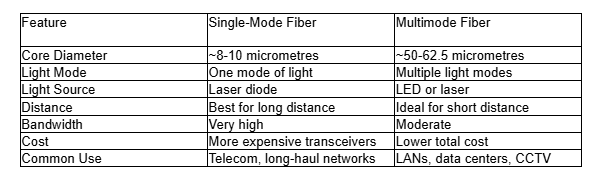
What Is Single-Mode Fiber?
Single-mode fiber uses one light mode to pass through the fiber core, meaning the signal travels in a straight path. This minimizes distortion or dispersion of the light and allows it to travel further.
Benefits of Single-Mode Fiber
- Transmits data at the highest bandwidth and over long distances (up to 100 km or more)
- Best for business parks, telecom service providers, and fiber-optic communication in wide-area networks
- Lower attenuation and interference
Considerations
- Requires single-mode transceivers, which can be more expensive
- Not ideal for short internal networks
- Installation can be more sensitive due to the narrow core diameter
Because single-mode fiber is limited to a single wavelength of light, it relies heavily on high-precision light sources like laser diodes, which adds to the cost of fiber technology.
What Is Multimode Fiber?
Multimode fiber optic cable has a larger core, which allows multiple light rays (modes) to be sent at once. While this increases data transmission volume over short distances, it introduces more modal dispersion.
Advantages of Multimode Fiber
- Cost-effective for short-distance applications
- Easier to install and align due to the larger core
- Compatible with cheaper light sources like light-emitting diodes (LEDs)
Where It Works Best
- Local networks (LANs)
- Cable television backbones
- Surveillance cameras and CCTV systems
- Data communication inside buildings or campuses
Limitations
- Limited bandwidth compared to single-mode
- Only supports up to about 550 meters with optimal gear
- Susceptible to signal distortion due to multiple light paths
Despite these limitations, multi-mode fiber uses multimode transceivers that are typically less expensive and easier to deploy in smaller networks.
Single Mode vs Multimode Fiber: Which Should You Use?
Choosing the Right Fiber
When asking yourself, “Should I use single-mode or multimode fiber?”, here’s what you should consider based on your needs:
- For long distances (more than 500 meters), go with single-mode fiber — it offers superior reach and less signal degradation.
- For shorter runs (within a building or campus), multimode fiber is often more cost-effective and easier to install.
Bandwidth Needs
If you’re moving large amounts of data, streaming high-resolution security footage, or supporting modern 100 Gigabit Ethernet networks, bandwidth matters. In general:
- Single-mode fiber supports much higher network throughput
- Multimode fiber may be limited in high-demand settings
Deeper Dive Into Fiber Optic Specifications
Fiber Core Diameter and Data Quality
- Single-mode fiber: Core diameter ~9 micrometres
- Multimode optical fiber: Core ~50 or 62.5 micrometres
A multimode fiber has a core that is significantly wider, which is why multiple beams of light (modes) can travel through simultaneously.
Transceiver Compatibility
Transceivers, which convert electrical signals into optical signals, are required for both types.
But:
- Single-mode transceivers typically use a laser diode and support higher bit rates
- Multimode transceivers use vertical-cavity surface-emitting lasers (VCSELs) or LEDs
Not all equipment is compatible across the board, so make sure your hardware matches the type of fiber optic cable you’re planning to install.
Cost and Installation Factors
Cost of Fiber Systems
- Multimode fiber tends to be cheaper upfront and is easier to install
- Single-mode gear is more expensive, but supports higher fiber count, making it more cost-efficient for large-scale use
If budget is your top concern and your distances are short, multimode and single-mode fiber installations reflect very different economics.
Infrastructure Considerations
When considering fiber optic network infrastructure, evaluate:
- Patch cable length
- Connector types (LC, SC, etc.)
- Wavelength dependency (commonly 850 nm and 1310 nm for multimode; 1310 nm and 1550 nm for single-mode)
- Laser source compatibility
Applications by Use Case
When to Use Single-Mode Fiber
Use single-mode fiber when:
- You’re building a large-scale telecommunications system
- Extending service across buildings or cities
- Supporting high-speed data-center interconnects
- Minimal signal loss and dispersion (optics) is critical
When to Choose Multimode Fiber
Opt for multimode fiber cable if:
- You’re connecting workstations in a single infrastructure
- Running fiber through the walls or ceilings of your office
- You need lower-cost structured cabling solutions for buildings or small campuses
These scenarios require a fiber that’s affordable and flexible, where the fiber is easier to install and maintain.
Future-Proofing and Technology Trends
Single-mode fiber is more scalable for evolving technologies like Terabit Ethernet, Wavelength-division multiplexing, and modern hyperscale data centers.
Still, the latest generation of multimode fiber is holding strong with optimized VCSEL sources and capabilities for Gigabit Ethernet and even 100 Gigabit Ethernet in shorter configurations.
If you’re building something new or planning upgrades, you’ll want your system to support future expansion. Choosing the right type of fiber optic now could save rework and costs down the line.
Conclusion: Choosing Between Single-Mode and Multimode Fiber
The core difference between single-mode and multimode fiber lies in how the light travels, the distances it can go, and how much data it can carry. Each cable type has its place – but selecting the right fiber will depend on your budget, expected performance, and future growth.
Here’s a quick recap:
- Choose single-mode for long-distance, high-speed applications like telecommunications or metro networks.
- Go with multimode for cost-efficient, short-distance needs like local office networks or security infrastructures.
No matter which kind of fiber you’re leaning towards, matching your decision to your actual requirements (and not just specs on paper) is vital.
Need help choosing the right fiber optic cable? Our friendly Texas team specializes in structured cabling solutions, and we’re happy to guide you through your options to ensure you get the performance, price, and reliability you need.
Let’s future-proof your network together. Reach out or share this blog with someone planning their next fiber upgrade.