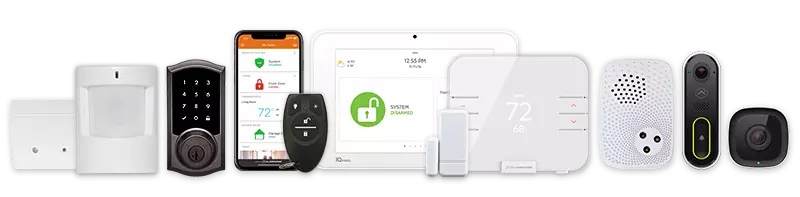
Alarm.com cameras offer smart Video Motion Detection — a feature that allows your camera to start recording automatically when something moves within its field of view. But to make this system work best for you, it’s important to understand and fine-tune three key settings: Motion Detection Windows, Target Size, and Sensitivity.
Let’s walk through each one.
1. Motion Detection Windows
What Are They?
Motion windows are custom zones you draw over your video screen where you want to detect motion. You can draw up to three motion windows per camera.
How to Use Them:
- Open the Alarm.com website or app
- Go to Video > Settings > Recording Rules
- Choose your camera and click Configure Motion Detection
- Use your mouse (or finger) to draw motion windows on the live video view
Best Practices:
| Tip | Why It Helps |
|---|---|
| Use small, specific boxes | Large boxes catch too much — smaller zones are more accurate |
| Focus on entry points | Target doors, garages, walkways, etc |
| Avoid windows or foliage | Reflections or swaying trees often trigger false alerts |
| Use “barrier lines” | Draw narrow horizontal/vertical windows people must cross |
Example: Draw a rectangle across the sidewalk leading to your porch — when someone walks across, it triggers a clip.
2. Target Size
What Is It?
Target size defines how much motion needs to be present within a detection window to trigger recording. It’s expressed as a percentage of the box’s area.
Why It Matters:
- A low target size (e.g., 1%) may trigger on small movements — like bugs or pets
- A high target size (e.g., 60%) may miss people unless they take up most of the zone
Best Practice:
- Start at 15–20% — this is ideal for detecting people
- Increase the target size if you’re getting too many alerts
- Decrease it slightly if you’re missing motion events
Real-world tip: If your porch area has a lot of blowing leaves, try increasing the target size to filter out small motion.
3. Sensitivity
What Is It?
Sensitivity controls how easily motion is detected, based on changes in pixel color or brightness.
- Set from 1 (low) to 10 (high)
- Higher sensitivity = picks up more subtle changes
- Lower sensitivity = ignores small motion and avoids false positives
How to Adjust:
- Start at level 7, which balances accuracy and stability
- If you’re not getting enough clips, try bumping up to 8–9
- If you’re getting too many false clips, reduce it to 5–6
Warning: If you’re on level 10 and still not getting motion events, you likely need to rework your motion windows and target size, not just sensitivity.
Common Problems & How to Fix Them
| Problem | Possible Fix |
|---|---|
| Too many false alerts | Reduce sensitivity; increase target size; move detection zones |
| Not recording when someone walks up | Draw narrower motion zones directly over paths; adjust target size down to 15% |
| Bugs or headlights triggering alerts | Avoid camera angles that face glass or open sky; set detection zones lower |
Bonus Tip: Use Hardwired Sensor Inputs (Advanced Users)
If your camera supports it (like models ADC-V520IR, V510, V720, or VS420), you can connect it to an external sensor like a motion detector.
- These sensors use Infrared rather than pixel change
- They are more reliable in rain, wind, or outdoor environments
- This option may require a professional installer
Ask your alarm provider if your camera has I/O ports and if a sensor upgrade is right for your environment.
Recap: Best Practices Checklist
- Use 2–3 narrow motion zones
- Avoid trees, glass reflections, and bright light zones
- Start with 15–20% target size
- Use sensitivity level 7 to start, adjust as needed
- Monitor your saved video clips and fine-tune settings weekly
- Ask about external sensors for difficult areas
Setup & Configuration
- alarm.com video motion detection
- alarm.com camera motion setup
- how to set motion zones alarm.com
- alarm.com motion detection windows
- motion zones for alarm.com camera
- alarm.com vmd setup guide
- motion rules alarm.com
- alarm.com adjust motion target size
- alarm.com target size motion detection
- alarm.com camera sensitivity settings
- adjust camera sensitivity alarm.com
False Alerts & Optimization
- stop false motion alerts alarm.com
- alarm.com vmd false alerts
- improve motion accuracy alarm.com
- alarm.com reduce camera motion notifications
- alarm.com best motion detection settings
- alarm.com detection zone placement
Troubleshooting & Performance
- alarm.com camera not recording motion
- alarm.com video recording triggers
- alarm.com camera motion event troubleshooting
- alarm.com outdoor camera motion tips
- alarm.com security camera guide
Advanced Features & Hardware
- alarm.com hardwired sensor input
- alarm.com i/o port camera setup
You can also refer to ADC Video Motion Detection PDF File for additional information.
Review the ADC V722W V522IR camera guide when adjusting motion settings. Learn more with adjust ADC doorbell motion sensitivity for better video motion settings. Learn more with add motion activated recordings ADC doorbell for motion-based recording setup. Improve multi-camera setup with Alarm.com dual camera support for better coverage.